Book review: Why Women Grow by Alice Vincent

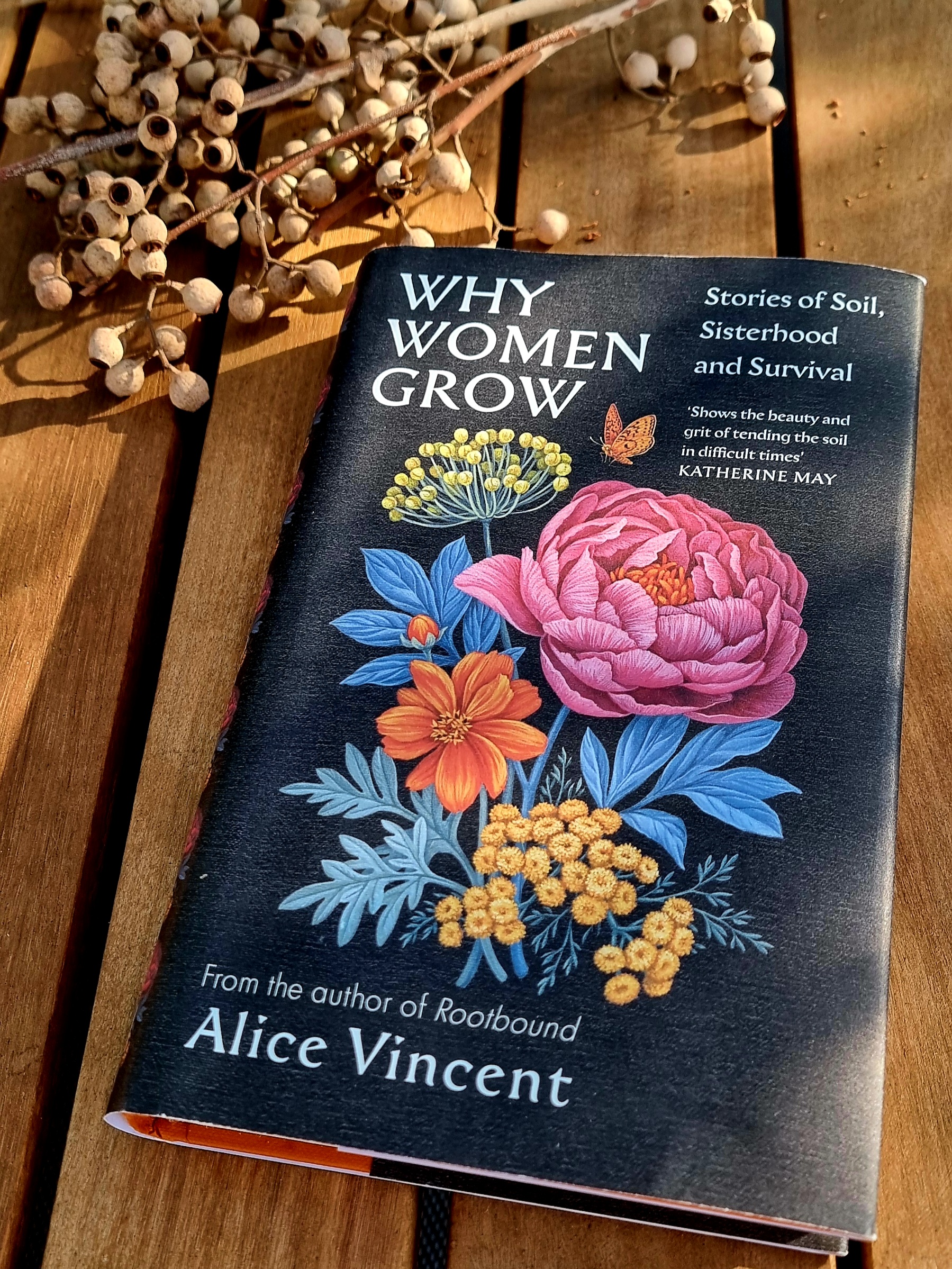
a copy of Why Women Grow on an outdoor table

I was gifted a copy of Why Women Grow by Alice Vincent last year, the giver saying they had started to read it and knew it was a book I’d enjoy. They were right, and I’m hoping that many of you will too.

Why Women Grow is a powerful book and one of those occasions of ‘you get out what you put in’. A lovely collection of touching stories if you just need a plant related read. But if you want to look a little deeper, it’s an opportunity to consider the role growing has in your life, what it has meant to you or someone you know, at different stages and situations. Each story brings a new reflection on how life, thoughts, family, community, politics, grief and self-care impact plant practice.

a copy of Why Women Grow on an outdoor tableAlice Vincent anchors the book in her own garden and reflections, experiencing the seasons and asking what is driving her to dive her hands into the soil. Her search for answers finds her interviewing women that grow, in a green space of their choosing. We are taken to private gardens, historical sites, public spaces and even a prison greenhouse, and insights are shared through touching stories of motherhood, loss, love, relationships, connection, activism and determination as each woman answers the question, why do you grow?

I took my time with this book, letting each story sink in and think about how I can relate, and I’ve continued to question what working the soil means to me. I urge you to dig into this book, and I ask, why do you grow?


Review by Bec Bennett

Who were your mentors?

I was fortunate to be mentored by generous and knowledgeable members of the Australian Walnut Industry Association, who openly shared their experience and encouraged my growth in the field. In my research work, I have benefitted greatly from the world-class facilities at the Gulbali Institute at Charles Sturt University. There, I was mentored by Professor Sandra Savocchia, an exceptional researcher whose guidance shaped much of my learning. I was also supported by a multidisciplinary team with expertise in plant pathology, biochemistry, and molecular analysis. I truly could not have asked for a better group of mentors. Throughout this journey, my husband David has been a constant source of support and encouragement, making it possible for me to pursue my studies and research wholeheartedly.

Group of 5 people standing in front of trees.

From left to right: Dr Ben Stodart, Prof. Sandra Savocchia, Dr Stella Antony, Dr Regina Billones-Baaijens, Prof. Chris Steel

What are you working on at the moment?

At the moment, I am working on a project that supports sustainable hazelnut production in Australia. Funded by AgriFutures Australia, the project has several themes and involves collaboration between several universities across the country. My role is within the sub-theme led by Professor Sandra Savocchia and focuses on evaluating potential disease threats to hazelnut production, including biosecurity risks linked to the import of plant material. The project also provides producers and nurseries with relevant information on disease management strategies to help minimise yield loss, and identifying areas for future research to ensure the long-term sustainability of the industry.

What does an average day consist of for you?

An average day for me starts with a cup of coffee and ABC classic FM in the background. After breakfast I check emails and respond to queries from nut growers, making sure they have the support and information they need. I usually set aside time to read the latest research updates on walnuts and hazelnuts, keeping up to date with developments in the field, and I continue working on writing and refining my research review. I also enjoy spending part of the day in my reasonably sized garden, tending to the fruit and nut trees. David and I try to fit in a daily hour’s walk around our quiet neighbourhood when the weather (and his kayaking schedule) allows. And although I’m no longer a full-time grower, harvest season is still special. During that time, we help friends in their orchards and share in the simple joy of harvesting together.

What is your favourite plant?

My favourite plant is the walnut tree. Beyond its value as a crop, it carries several fascinating mythological connections. In Greek mythology, the walnut tree is associated with Dionysus, the god of wine and ecstasy. He fell in love with Carya, the youngest daughter of the king of Laconia. When Carya’s jealous sisters tried to keep the two apart, Dionysus turned them into stone. Overcome with grief at their fate, Carya died of sorrow. Heartbroken, Dionysus transformed his beloved into a walnut tree, creating a lasting symbol of his love for her. For me, the walnut tree is more than a source of food – it is a living reminder of the beauty of love, the depth of loss, and the enduring power of myth.

Where do you see yourself in 5 years?

In five years, I see myself continuing to contribute to research that supports healthy, productive and resilient nut orchards across Australia, and helping growers access the knowledge and tools they need to manage emerging challenges with confidence.

What are your 3 most worthwhile tips that you can give to women who are starting out in the horticulture industry?

Build strong on-the-ground experience. Practical knowledge is invaluable and will shape your confidence and decision-making.

Follow your passion and don’t be limited by stereotypes. Be willing to challenge traditional expectations of women in primary production; your skills, interests and ambitions define your path.

Stay flexible and open to new directions. Horticulture offers many avenues, so don’t hesitate to explore different roles, learn new skills, or take unexpected opportunities as they arise.

Pin It on Pinterest

Share This